
Prospecting campaigns
Reach new shoppers using interest, broad and lookalike audience tests informed by product economics.

Reach high-intent shoppers across Facebook and Instagram with product-led creative, catalog campaigns, reliable purchase tracking and profitability-focused optimization.
Ecommerce Meta Ads help online stores introduce products, retarget engaged shoppers and convert demand across Facebook and Instagram. Campaigns can use product catalogs, customer signals and creative testing to match the right offer with the right audience.
Strong ecommerce Meta Ads management connects creative, audience, offer, product page and purchase tracking. Performance is judged by contribution margin, customer acquisition cost, return on ad spend and the quality of new-customer revenue.
See the paid customer journey ↓Creative, audiences, catalog sets, offers and landing pages are aligned with the products, margins and customer journey the brand needs to grow.
Reach new shoppers using interest, broad and lookalike audience tests informed by product economics.
Organize product sets by category, margin, availability and purchase behavior for more relevant delivery.
Reach customers searching for new customer, repeat purchase and product discovery journeys.
Test hooks, formats, proof, product demonstrations and calls to action without losing message clarity.
Ecommerce advertising weakens when creative, product economics, attribution and customer quality are reviewed in separate reports.
High engagement can still waste budget when the message does not qualify the product, price or offer.
Low-intent trafficDifferent categories and margins compete for budget while creative and product-page relevance become too generic.
Weak relevance and controlFrequency rises, response weakens and the same assets keep spending after they stop persuading shoppers.
Declining creative efficiencyTop-line ROAS can look positive even when discounts, returns and low-margin products reduce contribution.
Misleading revenue dataCampaign strategy, audience signals, ads, landing pages and conversion tracking work together to improve qualified purchase opportunities.
Build a structure that separates prospecting, retargeting and product priorities while giving each test enough budget to learn.
Develop audience hypotheses, creative angles and product-led messages for distinct awareness and buying stages.
Improve product and collection pages with consistent offers, useful proof, mobile clarity and a low-friction purchase route.
Validate Pixel and Conversions API events, then use margin and customer-quality feedback to improve delivery and budget decisions.
Campaigns perform best when audience, creative, offer, product page and retention support the same customer promise.
Audiences separate product-ready searches from general research, jobs and needs the business cannot serve.
The hook, format, proof and call to action help the shopper understand why the product is relevant.
Consistent pricing, benefits, reviews, delivery details and mobile UX make purchase decisions easier.
Purchase, margin and repeat-customer data identify which campaigns create sustainable growth.
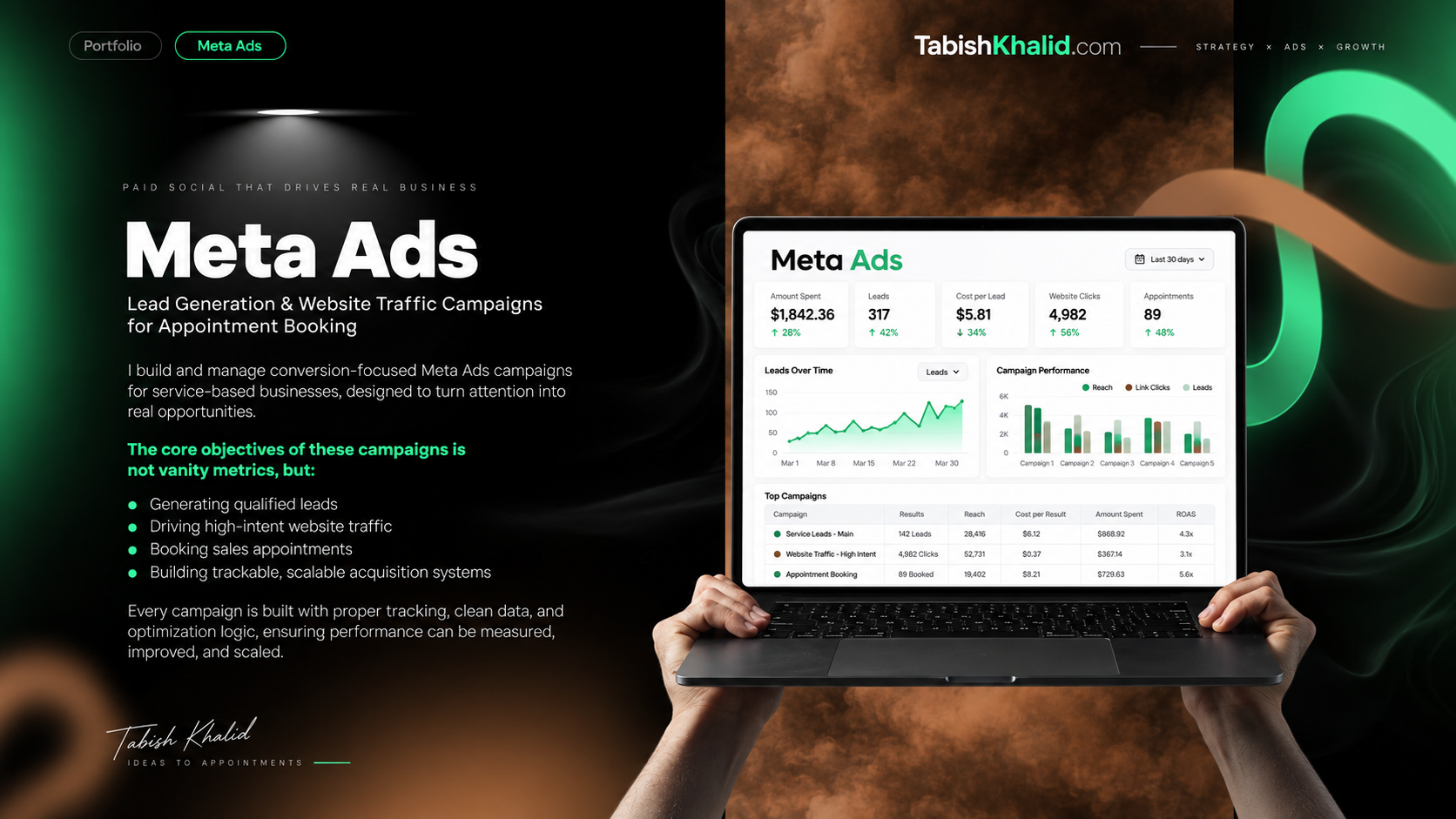
The account view connects audiences, creative, conversions and customer value so the next action is based on evidence.
Campaign, audience, creative, budget, catalog and tracking findings in one prioritized review.
Products, locations, intent groups and budgets mapped into a manageable account.
Priority audiences, match types, negative audiences and search-term review rules.
Clear, relevant messages and assets aligned with the service and landing page.
Calls, forms, orders and offline outcomes defined for consistent reporting.
Bid, budget, query and landing-page actions sequenced by impact and evidence.
Campaign, analytics, call and follow-up data are reviewed together before budgets are changed.
Reporting follows the customer journey from paid social impression to suitable purchase outcome.
Establish reliable measurement, control wasted spend and improve campaigns using customer-quality evidence.
Review services, locations, account history, audience signals, landing pages and existing conversion data.
Confirm tracking, campaign structure, audience controls, messages and budget priorities.
Monitor queries, ads, locations, bids and landing-page behavior while gathering useful conversion evidence.
Use purchase feedback to move spend toward the services and campaigns creating better opportunities.
Ecommerce Meta Ads promote products across Facebook and Instagram using creative, audience signals, product catalogs and conversion data. Strong campaigns connect the ad promise with a relevant product page and measurable purchase outcome.
Yes. Most eligible ecommerce brands can advertise through Meta, subject to commerce, product and advertising policies. Product claims, catalog data, landing pages and tracking should be checked before campaigns launch.
The right budget depends on average order value, margin, conversion rate, creative volume, audience size and the amount of data needed for useful learning. Planning begins with a target acquisition cost and a clear test period.
Waste is reduced through clear account structure, audience exclusions, creative testing, product-level reporting, reliable purchase tracking and regular budget reallocation. Margin and customer-quality data improve the decisions.
Usually, yes. A focused ecommerce landing page can explain one product or purchase need more clearly than a general homepage. It should include suitable proof, responsible claims, brand or store information and an obvious next step.
Reporting can connect impressions, clicks and conversions with suitable calls, checkout starts, completed orders and cost per paying customer where the business can provide that data.
Yes. The first step is an account audit covering campaign structure, audience signals, location settings, ads, landing pages, bidding and conversion tracking. The findings are then prioritized by likely commercial impact.
Share the products, margins, monthly spend and customer-acquisition challenge that matter most. The first review will identify the clearest test and measurement priority.