
Keyword lists lack business context
Volume alone does not show which searches attract suitable customers or profitable work.

Connect business priorities, keyword research, competitor gaps and page ownership so your team knows what to improve, create and measure.
The plan begins with the services, products and customers that matter, then maps real search behaviour to pages your team can improve and maintain.
Review my SEO direction ↗Find the point where search performance, page experience and business outcomes stop connecting.
Volume alone does not show which searches attract suitable customers or profitable work.
Unclear ownership creates duplication, internal competition and weak user journeys.
Activity grows while the highest-value service and comparison gaps remain unanswered.
Strategy turns research into a sequence the business can actually implement.
Discuss this scope ↗Clarify priority services, products, markets and qualified outcomes.
Separate research, comparison, local and purchase intent.
Find where competitors serve useful demand more clearly.
Assign ownership to existing, improved and new pages.
Sequence work and define how progress will be judged.
Focus the roadmap on the searches and pages most likely to support growth.
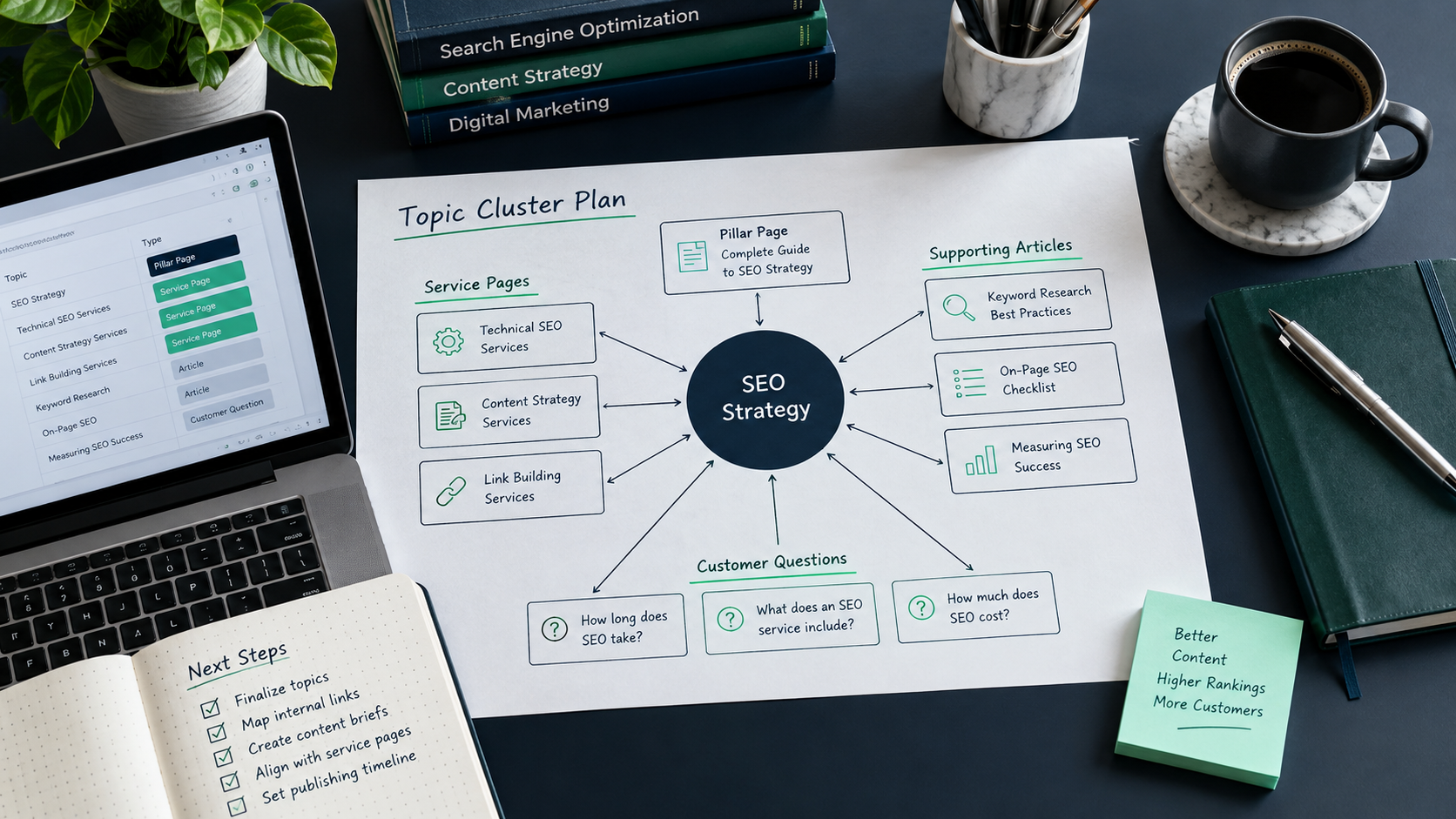
The final map shows which page owns the intent, what it must answer, how it connects to related content and what action should follow.
Discuss your search roadmap ↗Search opportunity becomes valuable when it matches the business model and the next customer decision.
Agree which searches, customers and outcomes matter commercially.
Give each important intent a clear destination.
Balance opportunity, effort, dependencies and measurement readiness.
Update priorities as query, page and lead-quality evidence changes.
The work is designed to support implementation and the next decision.
The relevant findings, affected pages and commercial context.
A sequenced set of recommendations with owners and dependencies.
A practical method for checking live changes and performance.
The SEO case study shows how diagnosis, page priorities and implementation decisions can be connected to performance evidence.

Each stage has a clear output and a decision before the next stage begins.
Confirm priority services, customers, commercial goals and what a valuable result looks like.
Review the relevant search, website, competitor and conversion evidence.
Complete the highest-value changes with clear owners and validation checks.
Compare search signals with useful enquiries or sales, then choose the next priority.
Search Console reveals current demand. Ahrefs and Semrush support competitive and keyword research. Analytics and CRM feedback help separate useful visits from low-value traffic.
Review my current position ↗Each platform answers a different question. The recommendation comes from the combined evidence, not a single tool score.
Each specialist page solves a different search problem. Use the related services to build the right combination without duplicating scope.
See the specific problems, scope, process and next step for this SEO service.
Explore Technical SEO ↗See the specific problems, scope, process and next step for this SEO service.
Explore On-Page SEO ↗See the specific problems, scope, process and next step for this SEO service.
Explore Content Strategy ↗See the specific problems, scope, process and next step for this SEO service.
Explore Local SEO ↗See the specific problems, scope, process and next step for this SEO service.
Explore Ecommerce SEO ↗See the specific problems, scope, process and next step for this SEO service.
Explore SEO Audit ↗SEO and paid-media clients share what mattered during the work: communication, clear priorities and an approach shaped around their business.
What the service covers, when it is useful and how progress is assessed.
An SEO strategy is a prioritized plan that connects search demand, website pages, technical needs, content and measurement to business goals.
Yes, but the research is organized by intent, commercial relevance and page ownership rather than delivered as an isolated keyword list.
Review priorities quarterly or when services, markets, website structure or competitive conditions change materially.
Clear entities, strong page ownership, useful answers and credible supporting content can help search and AI systems understand your expertise.
You receive an opportunity map, page plan, prioritized roadmap and measurement framework shaped around your website and team.
Share the services you want to grow, the markets you serve and the current website. We can identify the highest-value search priorities.
You can also message Tabish directly on WhatsApp.