
The page targets several intents at once
Mixed purposes make it difficult to answer one search need clearly.

Improve page relevance, structure, internal links and decision support so search engines understand the topic and visitors understand the value.
I improve the elements that help people and search engines understand what a page covers, who it serves and why it is useful.
Review my priority pages ↗Find the point where search performance, page experience and business outcomes stop connecting.
Mixed purposes make it difficult to answer one search need clearly.
Weak headings and structure hide useful answers and service detail.
Relevant pages stay disconnected from the decisions they support.
Every change should make the page easier to understand and more useful to the intended visitor.
Discuss this scope ↗Define the query group, audience and decision each page serves.
Improve clarity, hierarchy and search-result presentation.
Cover the people, services, processes and facts needed for the topic.
Connect supporting information and next-step pages naturally.
Place proof and CTAs where they support the visitor decision.
Start with priority URLs that have demand, visibility or commercial importance.
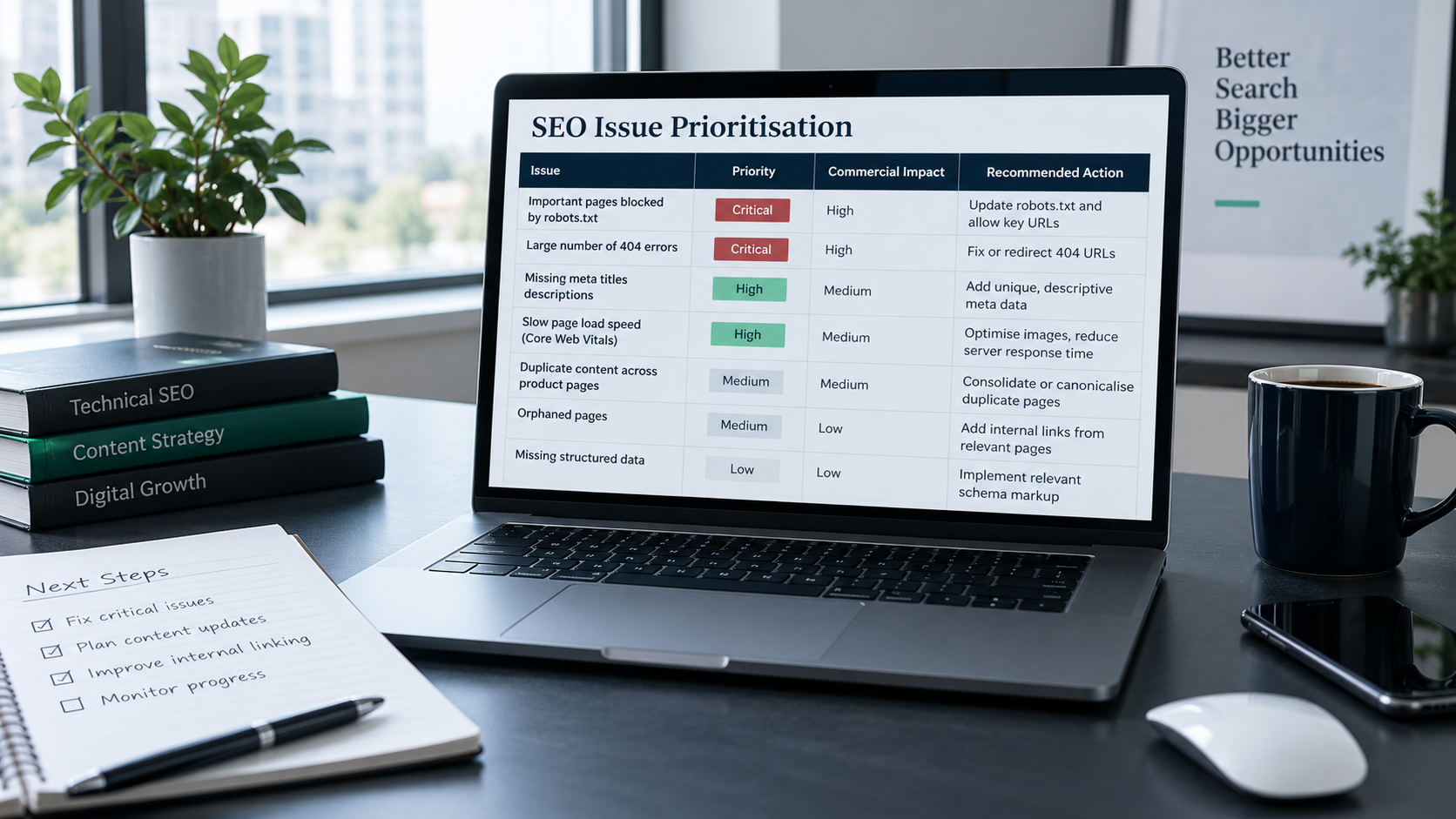
A useful page explains the offer, answers the right questions, provides credible support and makes the next step easy to understand.
Discuss priority page improvements ↗Strong on-page SEO combines search relevance with useful service detail and evidence.
Separate service, location, comparison and educational intent.
Cover fit, process, scope, risk and next steps where relevant.
Guide visitors and search engines to the next useful page.
Compare relevant queries, engagement and qualified actions.
The work is designed to support implementation and the next decision.
The relevant findings, affected pages and commercial context.
A sequenced set of recommendations with owners and dependencies.
A practical method for checking live changes and performance.
The related SEO case study shows how page relevance, site health and the enquiry path can be reviewed together.

Each stage has a clear output and a decision before the next stage begins.
Confirm priority services, customers, commercial goals and what a valuable result looks like.
Review the relevant search, website, competitor and conversion evidence.
Complete the highest-value changes with clear owners and validation checks.
Compare search signals with useful enquiries or sales, then choose the next priority.
Search Console reveals queries and pages. Analytics shows behaviour after arrival. Ahrefs and Semrush add competitor and topic context, while crawl data supports internal linking decisions.
Review my current position ↗Each platform answers a different question. The recommendation comes from the combined evidence, not a single tool score.
Each specialist page solves a different search problem. Use the related services to build the right combination without duplicating scope.
See the specific problems, scope, process and next step for this SEO service.
Explore Technical SEO ↗See the specific problems, scope, process and next step for this SEO service.
Explore SEO Strategy ↗See the specific problems, scope, process and next step for this SEO service.
Explore Content Strategy ↗See the specific problems, scope, process and next step for this SEO service.
Explore Local SEO ↗See the specific problems, scope, process and next step for this SEO service.
Explore Ecommerce SEO ↗See the specific problems, scope, process and next step for this SEO service.
Explore SEO Audit ↗SEO and paid-media clients share what mattered during the work: communication, clear priorities and an approach shaped around their business.
What the service covers, when it is useful and how progress is assessed.
On-page SEO improves page relevance and usability through titles, headings, content structure, entities, internal links, media and search-result information.
No. Writing may be part of the work, but on-page SEO also covers intent, structure, metadata, internal links and the relationship with other pages.
A page can cover a closely related query group when those searches share the same intent. Unrelated intents usually need separate pages.
Clearer value, proof, structure and next steps can support conversion, especially when the page already attracts relevant traffic.
Yes. Existing pages with demand or authority are often the best place to start before creating more content.
Share the pages that matter, their current search performance and the action you want visitors to take.
You can also message Tabish directly on WhatsApp.