

An SEO strategy for qualified leads identifies what suitable customers search for, builds the right commercial pages, supports them with focused content and measures whether organic visitors become enquiries, opportunities and customers.
Many websites begin SEO with a keyword list. That is too early. A keyword can have high search volume and still attract people who will never buy. Strategy begins with the business, the customer and the decision the website must support.
What does an SEO strategy include?
An SEO strategy is a prioritized plan for improving how search engines discover, understand and present a website while helping potential customers find useful answers. Google describes SEO as helping search engines understand content and helping users decide whether they should visit a result.
A commercial SEO strategy should connect five areas: technical access, search intent, page architecture, content authority and conversion measurement. Treating these areas separately often creates traffic without commercial progress.
| Area | Question | Business purpose |
|---|---|---|
| Technical foundation | Can important pages be crawled, rendered and indexed? | Protect visibility |
| Search demand | What problems and services do suitable customers search for? | Capture relevant demand |
| Page structure | Does each important intent have a clear destination? | Prevent confusion and overlap |
| Content support | What evidence and explanations help the buyer decide? | Build trust and authority |
| Measurement | Which organic visits become useful enquiries? | Guide investment |
Is your SEO producing traffic but few enquiries?
A focused review can identify whether the constraint is search intent, page structure, technical access or conversion friction.
Explore the SEO audit service ↗Traffic strategy versus qualified-lead strategy
A traffic strategy prioritizes keywords that can increase visits. A qualified-lead strategy prioritizes searches that reveal a relevant problem, evaluation process or buying decision.
Informational content remains useful, but it needs a role. A definition can introduce a concept. A guide can explain the process. A comparison can help evaluation. A service page should make the commercial next step clear. These page types should support one another rather than compete for the same query.
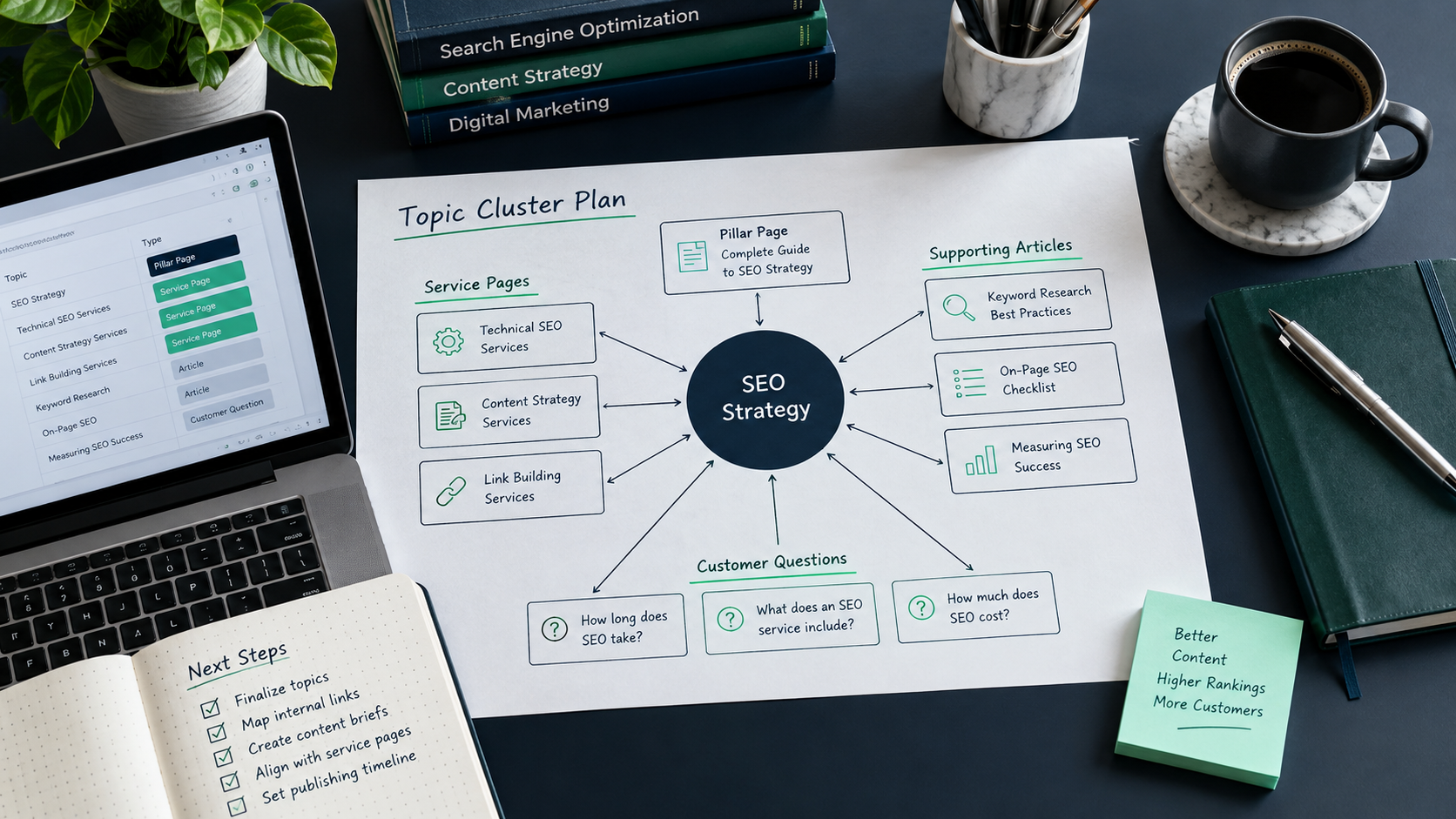
A seven-step SEO strategy framework
1. Define the commercial outcome
Choose the service, product or market the strategy must support. Record the average customer value, suitable customer profile, sales process and current lead quality. This prevents keyword volume from becoming the only decision metric.
2. Map customer problems and buying stages
List what customers ask before they understand the problem, while they compare solutions and when they are ready to speak with a provider. Use sales calls, enquiries, customer interviews, Search Console and internal search data.
3. Separate informational and commercial intent
Commercial terms usually deserve service, product, category or comparison pages. Informational questions usually deserve articles, glossary definitions or guides. One URL should have one main purpose.
4. Build the service-page architecture
Create the commercial structure before scaling blog content.
Start with a complete overview of your SEO consulting services. This page should help buyers understand the full system and choose the right path.
Use dedicated pages for specific needs. A business facing crawl and indexing problems should reach a page about technical SEO audits and implementation.
A team planning an editorial programme should reach SEO content strategy services. Businesses that depend on nearby customers should be directed to local SEO services for qualified enquiries.
5. Design supporting content clusters
Each blog should support a target service page. Avoid publishing an article only because a keyword tool reports volume. Confirm that the topic helps a relevant customer understand a problem, evaluate a solution or take action.
6. Fix technical barriers
Review internal links, canonical signals, sitemaps, robots directives, rendering and page performance. Google can discover many pages through crawlable links, while sitemaps can improve discovery for larger or more complex websites.
7. Improve conversion paths
Make the next step visible without interrupting the reader. A useful CTA can offer a related checklist, calculator, audit or service. The offer should match the problem discussed in that section.
How to measure an SEO lead strategy
Rankings and traffic are diagnostic measures, not final outcomes. Use them to understand visibility, then connect them with commercial actions.
| Metric | What it reveals | Decision it supports |
|---|---|---|
| Qualified organic leads | Whether suitable visitors enquire | Content and page investment |
| Organic conversion rate | How well pages turn visits into action | CRO priorities |
| Assisted conversions | Whether content supports later enquiries | Cluster value |
| Non-brand commercial clicks | Visibility beyond existing awareness | Market expansion |
| Lead-to-opportunity rate | Quality after the form | Intent and offer alignment |
Common SEO strategy mistakes
Choosing topics only by search volume
High volume can create impressive reports while attracting the wrong audience. Relevance, achievable visibility and commercial contribution should guide priority.
Writing blogs before building service pages
Supporting content needs a clear page to support. Otherwise authority and visitors have no commercial destination.
Publishing overlapping articles
Several pages that answer the same intent can weaken signals and create an unclear user journey. Map one primary purpose to each URL before writing.
Reporting leads without checking quality
A form submission is not automatically a qualified lead. Where possible, connect analytics with CRM stages and closed outcomes.
Build the commercial structure before adding more content.
SEO strategy services connect demand, architecture, content and measurement around the services you want to grow.
View SEO strategy services ↗How to research keywords with commercial context
Keyword research should explain demand, not simply export phrases from a tool. Start with the services you can deliver profitably, the customers you are equipped to help and the problems that normally trigger a buying decision. Then collect the language used in sales calls, enquiry forms, customer emails, Search Console and competitor search results.
Group terms by the decision behind the query. A person searching for a definition may need education. Someone searching for a provider, price, audit or comparison is much closer to action. Both can be valuable, but they need different pages and different next steps.
| Query pattern | Likely need | Best page type | Useful next step |
|---|---|---|---|
| What is technical SEO? | Understand a concept | Guide or glossary | Read the audit checklist |
| Technical SEO audit service | Evaluate a provider | Service page | Request an audit |
| SEO audit cost | Compare options and budget | Pricing or buying guide | Discuss scope |
| Why is organic traffic dropping? | Diagnose a problem | Troubleshooting guide | Run a diagnostic review |
Search volume is only one input. Also assess business fit, intent strength, current visibility, competition, expected conversion path and the evidence required to satisfy the query. A lower-volume service term can be more valuable than a broad term that attracts thousands of students, job seekers or people outside your market.
Map content to the customer journey
A strong cluster does not repeat one keyword across many posts. It answers the sequence of questions a suitable buyer asks while moving from problem recognition to provider selection. This creates a natural path from education to evaluation without forcing a sales pitch into every paragraph.
Problem recognition
At this stage, readers may not know which service they need. Content should help them identify symptoms, separate likely causes and understand the cost of leaving the issue unresolved. Examples include declining non-brand clicks, rising acquisition costs, poor lead quality and service pages that attract visits but no enquiries.
Solution evaluation
Readers now understand the problem and want to compare approaches. Publish frameworks, checklists, process explanations and honest comparisons. Explain what can be handled internally, what normally requires specialist input and which dependencies affect results.
Provider selection
Commercial pages should make scope, process, fit and expected deliverables clear. Include relevant proof, explain how work is prioritized and remove uncertainty around the first step. Avoid unsupported guarantees. Credibility comes from specificity and a transparent method.
Build service pages before scaling the blog
Each important service intent needs a clear destination. A parent page can introduce the complete capability, while child pages address distinct needs such as technical SEO, local visibility, content strategy or an SEO audit. Supporting articles should link to the most relevant child page, not automatically to the homepage.
Before publishing a new URL, compare it with every existing page targeting similar language. If the same visitor would expect the same answer from both pages, improve the stronger page instead of creating another. If the intent, audience or required solution is genuinely different, a separate page may be justified.
| Page | Primary job | Content it should contain |
|---|---|---|
| Parent service page | Explain the full capability | Problems, approach, linked specialisms, proof and enquiry path |
| Child service page | Convert a specific service need | Scope, process, deliverables, fit, evidence and FAQs |
| Supporting guide | Answer a substantial question | Direct answer, method, examples, sources and contextual CTA |
| Glossary entry | Define a term clearly | Short definition, practical context, related concepts and deeper reading |
| Case study | Demonstrate a relevant outcome | Starting point, diagnosis, actions, evidence, limitations and result |
A practical 90-day execution plan
Days 1 to 30: establish the baseline
Confirm analytics and conversion tracking, segment branded and non-branded performance, review index coverage and map existing pages to intent. Interview the people closest to customers. Record which enquiries become genuine opportunities, because form volume alone can hide poor targeting.
At the end of this phase, you should have a prioritized issue register, an approved page map and a measurement baseline. Do not start a large publishing schedule while important pages are blocked, duplicated or mapped to the wrong intent.
Days 31 to 60: improve commercial destinations
Rewrite or rebuild the service pages that matter most. Clarify who the service is for, the problem it solves, how the engagement works and what a suitable visitor should do next. Strengthen titles, headings, internal links and supporting evidence. Resolve technical issues that prevent reliable crawling, indexing or rendering.
Days 61 to 90: publish the first supporting cluster
Create a small set of substantial articles around the questions that appear repeatedly in sales conversations and search data. Link each guide to its service destination and to closely related articles where the connection is useful. Review early impressions, click-through rate, engagement and assisted enquiries before increasing output.
What a useful SEO content brief should contain
A brief should give the writer enough commercial and factual context to produce a distinctive page. It should not reduce writing to filling a template. Include the primary reader, the decision they are making, the main question, supporting questions, target service page, required evidence, internal links, credible external sources and the next action.
Review the current search results to understand format and expectations, then look beyond them. Sales objections, account data, screenshots, original examples and expert experience can add information that competing summaries do not provide. Every claim that could affect a business decision should be supported or carefully qualified.
Improve conversion without weakening the article
A useful article earns attention before asking for action. Place the first CTA after the reader has understood the core issue, a second near the implementation section and a final CTA after the guide has answered the main question. Each CTA should offer the logical next step.
For diagnostic topics, an audit is relevant. For planning topics, a strategy call or downloadable framework may fit better. Keep forms short at the first point of contact and state what happens after submission. On mobile, ensure the CTA is readable, the tap target is large enough and the form does not create unnecessary friction.
Turn search demand into a connected acquisition path.
I can review your current service architecture, content gaps and conversion journey, then translate the findings into a prioritized roadmap.
Discuss your SEO roadmap ↗Review and update the strategy
SEO strategy is not a document that remains unchanged for a year. Review performance monthly at page and query level, then conduct a deeper quarterly review of commercial priorities, competing pages, technical health and lead quality. Update pages when the offer, evidence, search behaviour or official guidance changes.
Do not change content simply to alter the publication date. A useful update adds current evidence, improves an incomplete explanation, resolves overlap or reflects a genuine change in the market. Keep a change log so later performance can be interpreted against the work completed.
Examples for different service businesses
Local professional service
A local accounting practice may need a parent accounting services page, distinct pages for tax planning and bookkeeping, strong location and trust signals, and guides addressing deadlines, records and service selection. Local visibility matters, but creating dozens of nearly identical city pages is rarely a sound substitute for genuine local relevance.
Business-to-business consultancy
A consultancy with a longer sales cycle should focus on specific commercial problems and decision roles. Service pages can explain scope and delivery, while supporting content addresses evaluation questions, internal business cases and common implementation risks. The primary conversion may be a discovery call, but case studies and detailed methodology often assist the decision before that call occurs.
Home service company
A home service strategy usually combines clear service-area coverage, urgent and planned service intent, accurate business information and an easy mobile enquiry path. Separate pages can be useful when each service has distinct customer questions and evidence. Calls, booking forms and qualified jobs should be measured, not only map views.
Quality control before publishing
Confirm that the article answers its main question near the beginning, uses one descriptive H1 and provides a logical heading structure. Check every factual claim, external source, internal link, image description and CTA. Remove repeated paragraphs and vague claims that could appear on any competing website.
Read the draft as a potential customer. Can the reader understand what to do, why it matters and when professional help may be useful? Then review it as a search engine would encounter it. Is the page crawlable, indexable, canonical, internally linked and fast enough to use comfortably?
Finally, review the commercial connection. The supporting article should lead to a relevant service without hiding the answer. Track the page separately so later updates are based on impressions, clicks, engagement, assisted conversions and lead quality rather than opinion alone.
Frequently asked questions
How long does an SEO strategy take to produce results?
The timeline depends on the website, competition, technical condition and available resources. Early technical and page improvements may appear sooner, while authority and competitive visibility usually develop over a longer period.
How many blogs should support one service page?
There is no fixed number. Publish enough content to answer the important questions around the service without creating overlapping pages. Quality and complete intent coverage matter more than volume.
Should every blog contain a sales CTA?
Every blog should provide a relevant next step, but it should match the reader's stage. A checklist or audit may be more useful than an immediate consultation request.
Can SEO be measured by revenue?
Yes, when analytics, lead tracking and CRM stages are connected. Revenue attribution may be direct or assisted depending on the sales cycle.