
Audience fit
Reviewed who should see the offer and who should be excluded.
Case Studies/Meta Ads
 Meta Ads
Audience, creative, tracking and follow-up were treated as one acquisition journey instead of separate campaign tasks.
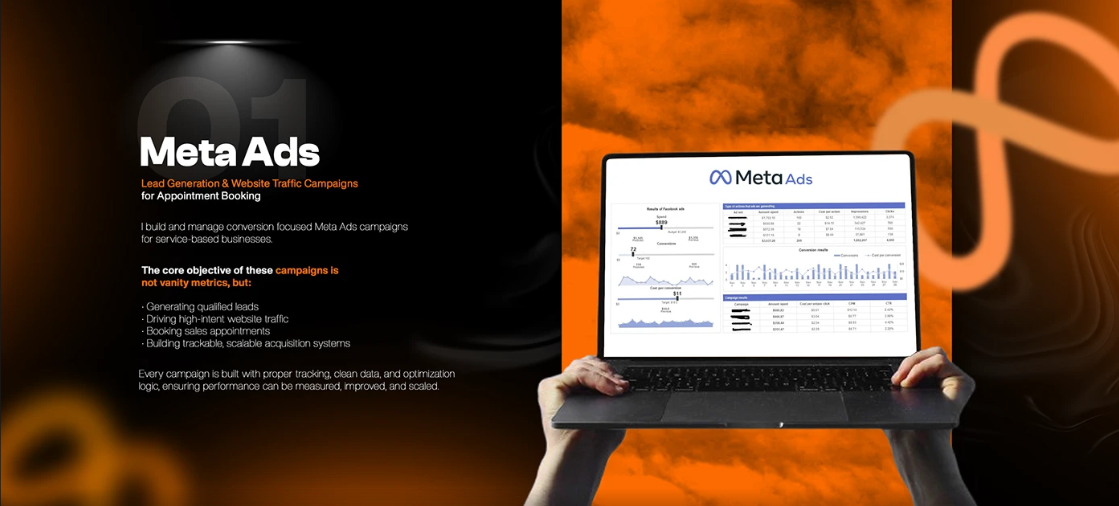
The account could generate platform activity, but low-friction leads did not always become useful sales conversations. The campaign needed a clear definition of quality and a better route from first impression to response.
The audit connected channel data with page experience and lead quality.
Reviewed who should see the offer and who should be excluded.
Compared hooks, proof and offer angles with customer needs.
Checked the balance between response volume and qualification.
Reviewed speed, message continuity and appointment handoff.
Figures are not reconstructed. Screenshots remain intact inside branded presentation frames.
Meta Ads executionEvidence 01Meta event trackingEvidence 02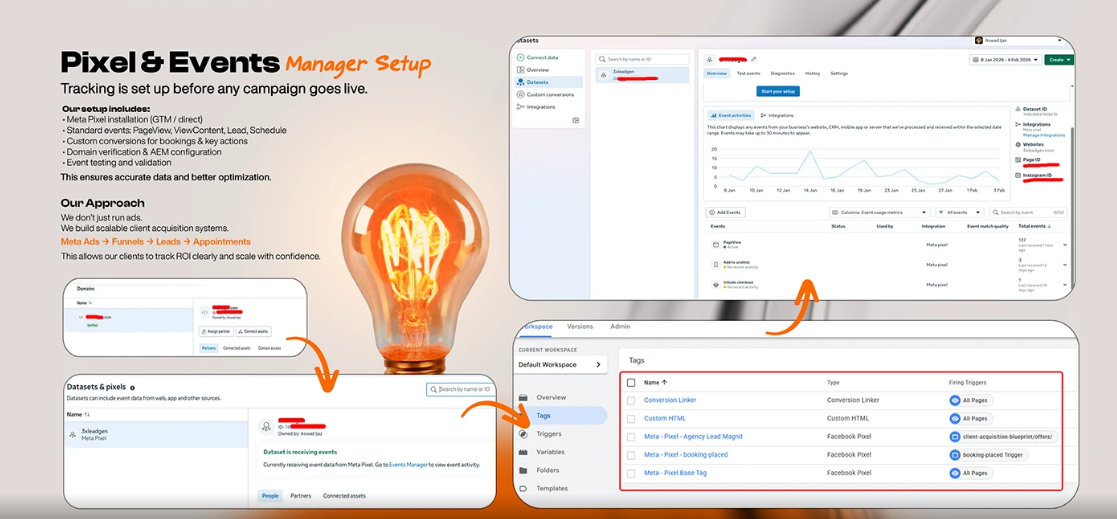
Evidence policy: Account names, customer data and commercially sensitive details remain confidential. A screenshot proves only what is visible inside that screenshot.
Qualification criteria were agreed before campaign changes.
Each test examined one audience or message hypothesis.
The promise continued from ad to form and booking step.
Pixel events and conversion actions were reviewed before scaling.
Leads were reviewed by response and appointment progress.
The outcomes below describe the verified implementation and learning. They do not promise identical results for another business.
Campaign decisions used an agreed lead definition.
Creative tests produced specific, reusable insight.
Review moved beyond cheap leads to useful conversations.
Start with the commercial constraint, then choose the channel work that can solve it.
Share the service you want to grow, the evidence already available and where performance currently slows down. The first review identifies the most useful next step.
Understand the process, evidence and commercial focus before deciding whether this approach fits your goals.
Lead quality improves when the audience, offer, creative, form questions and follow-up process work together. I review all five areas and use sales feedback to separate cheap leads from commercially useful enquiries.
Not always, but the account needs enough strong angles and formats to learn. Existing creative is assessed first, then gaps are prioritized around the customer problem, proof, offer and reason to act.
The best option depends on intent, offer complexity, tracking and follow-up speed. Instant forms can reduce friction, while landing pages can provide more context and qualification. Both can be tested with clear quality measures.
Reporting can include qualified lead rate, booked calls, sales progress, revenue and creative-level learning. This prevents the platform from being judged only by the cheapest initial conversion.
Access to the ad account, pixel or Conversions API setup, landing pages and any available CRM lead outcomes is ideal. We can still begin with the account and website if sales-stage data is limited.
Share your website, priority service and current acquisition challenge.